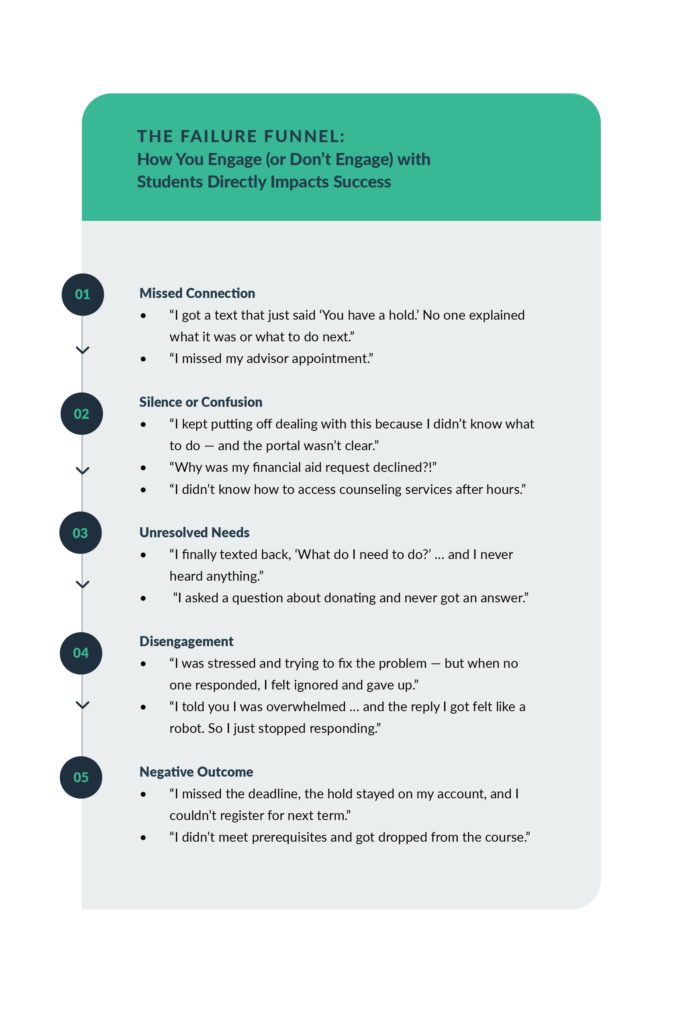
The Failure Funnel is not about a lack of caring. It is about a lack of capacity. As shown in the Failure Funnel chart in our AI & the New Retention Playbook, students do not disappear all at once. They leak out slowly at each transition point.
Higher education teams are being asked to do more with fewer people. Students expect immediate, personalized responses across text, chat, and mobile. Meanwhile, staff are juggling hundreds or thousands of students at once.
Traditional outreach methods do not scale well in this environment.
Mass email reminders get ignored.
Manual follow up is inconsistent.
Insight into why students disengage is often anecdotal at best.
The result is reactive intervention instead of proactive support. By the time a student raises their hand, they may already be halfway out the door.
The Hidden Cost of Inaction
The Failure Funnel is not just a communication issue. It is a revenue issue. A retention issue. A student experience issue.
When friction is not addressed quickly:
Yield declines
Melt increases
Stop outs rise
Staff burnout grows
Most institutions do not lack data. They lack visibility into real time student intent and the capacity to act on it consistently.
What if every moment of hesitation could trigger support? What if confusion was identified before it became withdrawal?
A New Retention Playbook
The next generation of student engagement is not about sending more messages. It is about completing more outcomes.
Modern AI systems can engage students in two-way conversations, detect confusion or urgency, follow up automatically, and escalate to staff when needed. They do not replace your team. They extend it.
Instead of waiting for students to fall through the funnel, institutions can close the gaps in real time.
The goal is simple: Reduce friction, increase completion, and preserve human capacity for the moments that matter most.
In our full AI & the New Retention Playbook 2026, we break down the Failure Funnel in more detail and outline what a proactive, AI supported retention strategy can look like in practice.
Because the future of retention will not be defined by how many messages you send. It will be defined by how many students you move forward.
The Failure Funnel describes the points in the student lifecycle where students drop off due to friction, confusion, or lack of timely support. Rather than one major failure point, students often disengage gradually between stages like application, financial aid, registration, and persistence. The Failure Funnel highlights how small breakdowns compound into lower enrollment and retention
Why do students fall through the cracks during enrollment?
Students fall through the cracks when communication is delayed, unclear, or inconsistent. Common causes include unanswered financial aid questions, incomplete applications, confusing housing processes, or registration holds. When institutions rely on manual follow up or mass email reminders, students who need personalized support may disengage before staff can intervene
How does friction impact student retention?
Friction creates uncertainty and hesitation. When students encounter repeated obstacles without quick resolution, momentum slows. Over time, this can lead to melt, stop outs, or full withdrawal. Even small delays in response time can significantly impact enrollment yield and year over year retention rates.
What are the most common breakdown points in the enrollment funnel?
Common breakdown points include:
Incomplete applications
FAFSA or financial aid confusion
Missing documents
Registration holds
Housing process misunderstandings
Lack of clarity around next steps
These friction points often occur between major lifecycle milestones.
Identify students who have paused in key processes
Send timely reminders and nudges
Detect confusion or frustration in conversations
Escalate high risk students to staff quickly
Automation and AI driven follow up can significantly reduce melt by maintaining momentum through each stage of the funnel.
How does AI help improve student retention?
AI can engage students in two-way conversations, detect intent or confusion in real time, automate routine follow ups, and escalate complex issues to staff. Instead of simply sending reminders, AI systems can help complete tasks such as scheduling meetings, tracking missing items, and resolving common questions. This increases consistency while preserving staff time for high impact interactions.
Are AI Agents replacing admissions or advising staff?
No. AI Agents are designed to extend institutional teams, not replace them. They handle repetitive, routine tasks and after hours engagement so staff can focus on complex conversations, relationship building, and high risk student interventions. Human oversight and escalation remain essential.
What metrics should institutions track to measure retention impact?
Key retention metrics include:
Application completion rates
FAFSA completion rates
Yield and deposit conversion
Registration completion
Stop out rates
Year over year persistence
Institutions should also monitor engagement signals such as reply rates, sentiment trends, and time to resolution in student conversations.
What is proactive student engagement?
Proactive engagement means reaching students before they disengage. Instead of waiting for a student to ask for help, institutions use data, conversation insights, and automation to anticipate needs, send targeted guidance, and intervene early. Proactive engagement reduces friction and supports student momentum.
How can institutions close gaps in the student lifecycle?
To close lifecycle gaps, institutions must:
Centralize communication channels
Use real time conversation data to detect risk
Automate routine follow ups
Provide 24/7 access to support
Align enrollment, advising, and success teams
By reducing communication silos and acting on engagement signals, institutions can shrink the Failure Funnel and improve retention outcomes.