



Advancement AI Agents AI in Higher Education Blog Enrollment Student Success
Aug 27 2026
AI Agents vs. AI Chatbot for Higher Education: FAQ for Admissions, Student Success, and Advancement




Human-in-the-loop AI means a person can see every conversation an AI agent has, step into any of them, and gets pulled in automatically when a student needs more than a routine answer. Here’s what oversight, escalation, and transparency actually look like in a real student success workflow, not on a vendor slide.
Grace Lee has a rule for herself: before she trusts anything new in her advising office, she watches it fail safely first. Three weeks into her team’s rollout of the Inbox Assistant, she gets her answer. A student texts to ask about a withdrawal deadline, then adds, almost as an afterthought, that they’ve been thinking about leaving school for good.
The Inbox Assistant answers the deadline question in seconds. The second sentence, it doesn’t touch. It flags the thread, marks it high priority, and routes it to Grace’s queue before she’s finished her coffee.
That moment is what convinces a skeptical advising director, not a slide about human-in-the-loop AI. Advisors have heard “the human stays in control” before, usually right before that control turns out to be a settings toggle nobody actually checks.
What earns trust is watching a system handle the routine work correctly, then hand off the situations that need a person, every single time, without being asked twice.
As Ryan Nellenback, an enrollment leader at Onondaga Community College, put it at a recent Mongoose User Group session: “The AI component is wonderful, but attach it to a person.”
Students describe wanting the same mix. A February 2026 EDUCAUSE Review analysis found that even though most students now use generative AI weekly, the large majority still turn to a person first when they’re stuck on something that actually matters to them, not a bot. Advisors want that same guarantee for themselves: AI can take the routine, but a person is always the backstop.
Human-in-the-loop is a specific design choice, not a marketing phrase. You’ll sometimes see it shortened to HITL in technical documentation, though advisors rarely talk that way at their desks. It means a system can handle a task on its own, but a person can see what it did, override it, and gets automatically looped in the moment the task crosses into judgment territory.
Underneath, the Inbox Assistant runs on machine learning and large language models, not a decision tree built from a script advisors have to maintain. That matters for human-in-the-loop design specifically, because a model trained on broad patterns of language will occasionally guess wrong on something narrow and specific to one student.
The point of the loop isn’t to pretend that never happens. It’s to make sure a person catches it before it reaches a student unsupervised. In student success work, human-in-the-loop shows up in three concrete places: oversight, escalation, and transparency.
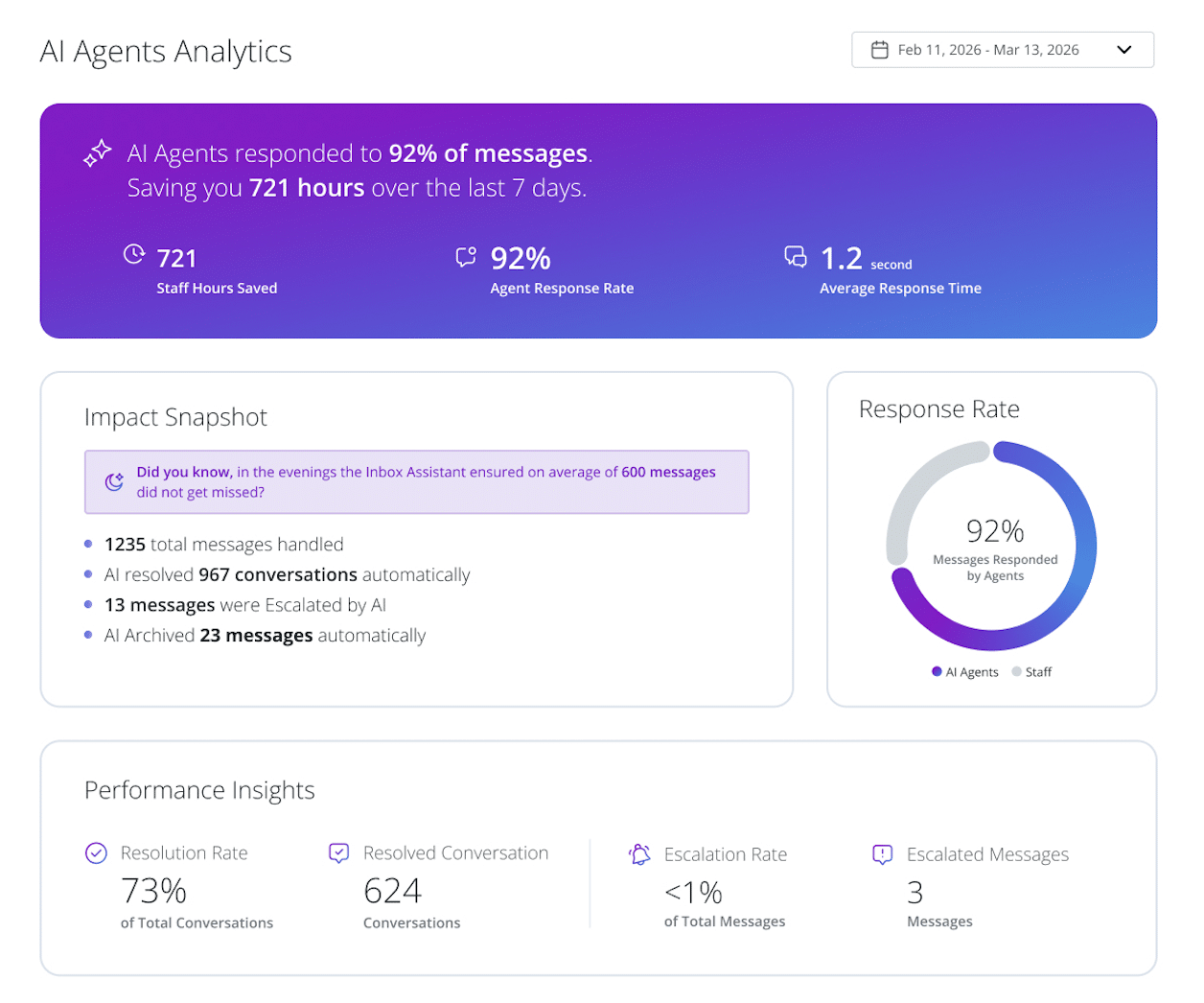
Oversight is the least glamorous part of this design and the part advisors check first. It’s the queue an advisor actually opens every morning, not a dashboard filed away somewhere for an audit.
With the Inbox Assistant, every conversation stays visible to the team in real time, the same inbox staff already use. An advisor can read the full thread, see exactly what was answered and from what approved knowledge, and take over a conversation at any point. Every handoff leaves an audit trail, so a director can trace exactly which message triggered a review and when, not just that it happened. Nothing sits in a black box a director has to request access to see.
That’s human review built into the workflow, not bolted on after the fact. Advisors also shape the system over time. When an advisor corrects something or flags a miss, that human feedback narrows what counts as routine going forward, so the line gets sharper the longer a team uses it.
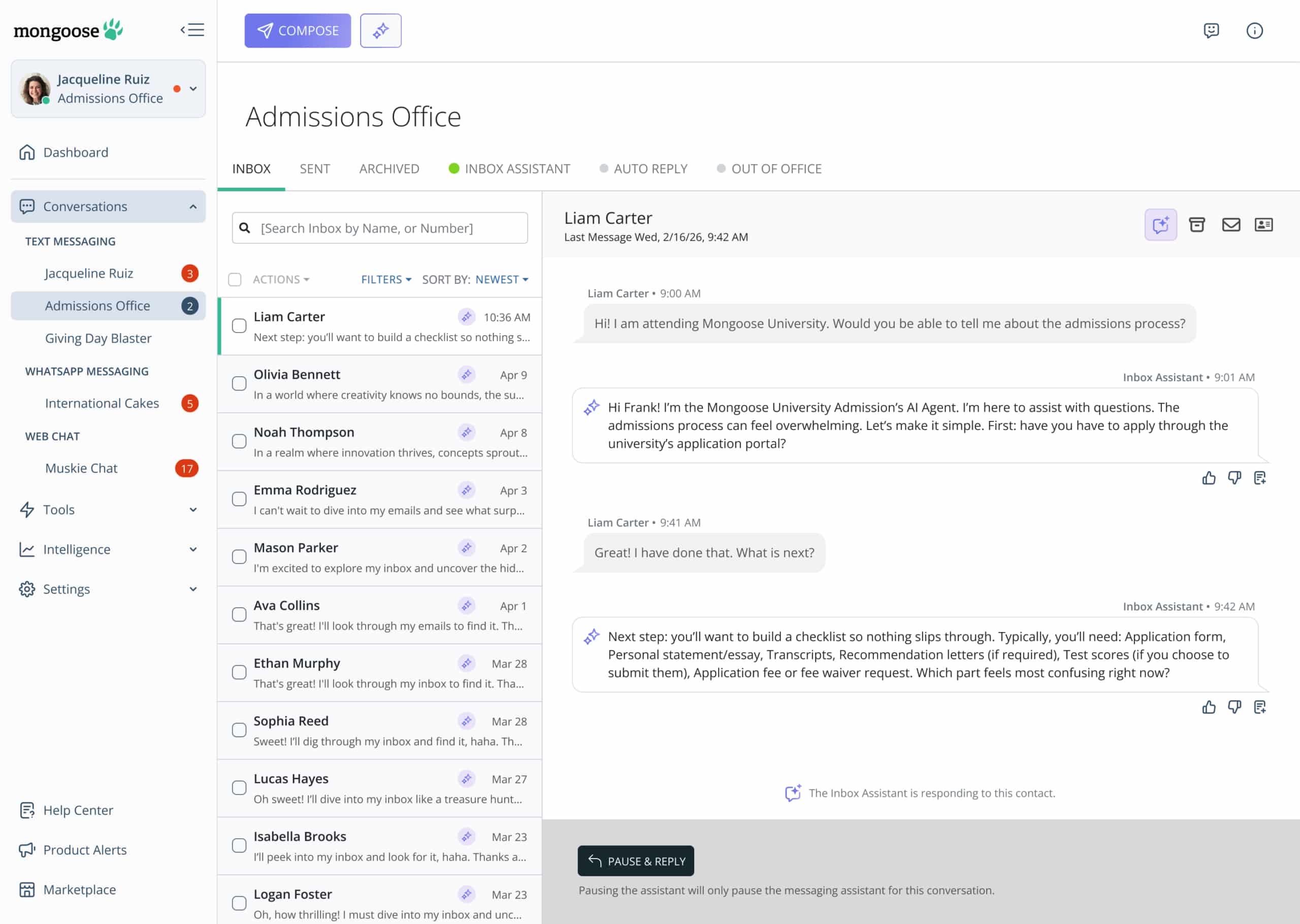
That visibility is also what lets a director like Grace decide what “good” looks like for her own team. Advising offices don’t all draw the line in the same place, and they shouldn’t have to. A community college advising team managing 400-student caseloads may want the Inbox Assistant to handle more of the routine load. A smaller private institution’s team may keep a tighter leash while they build confidence.
Both are human-in-the-loop. The loop is just set where the team decides it should sit.
Escalation is the part that matters most the day something goes wrong, or the day a student says something that isn’t routine at all.
The Inbox Assistant reads and analyzes incoming messages, answers common questions from approved institutional knowledge, and flags high-priority messages so they escalate to a person, not because a staff member remembered to check, but because that’s how the system is built to work.
The line for what escalates isn’t guesswork. An institution’s own staff define what counts as routine and what doesn’t, using the knowledge base and rules they control. A question about a registration hold or a financial aid deadline can be routine. A student mentioning they’re struggling, considering withdrawing, or describing a situation that needs judgment calls for human intervention, and it’s never treated as routine.
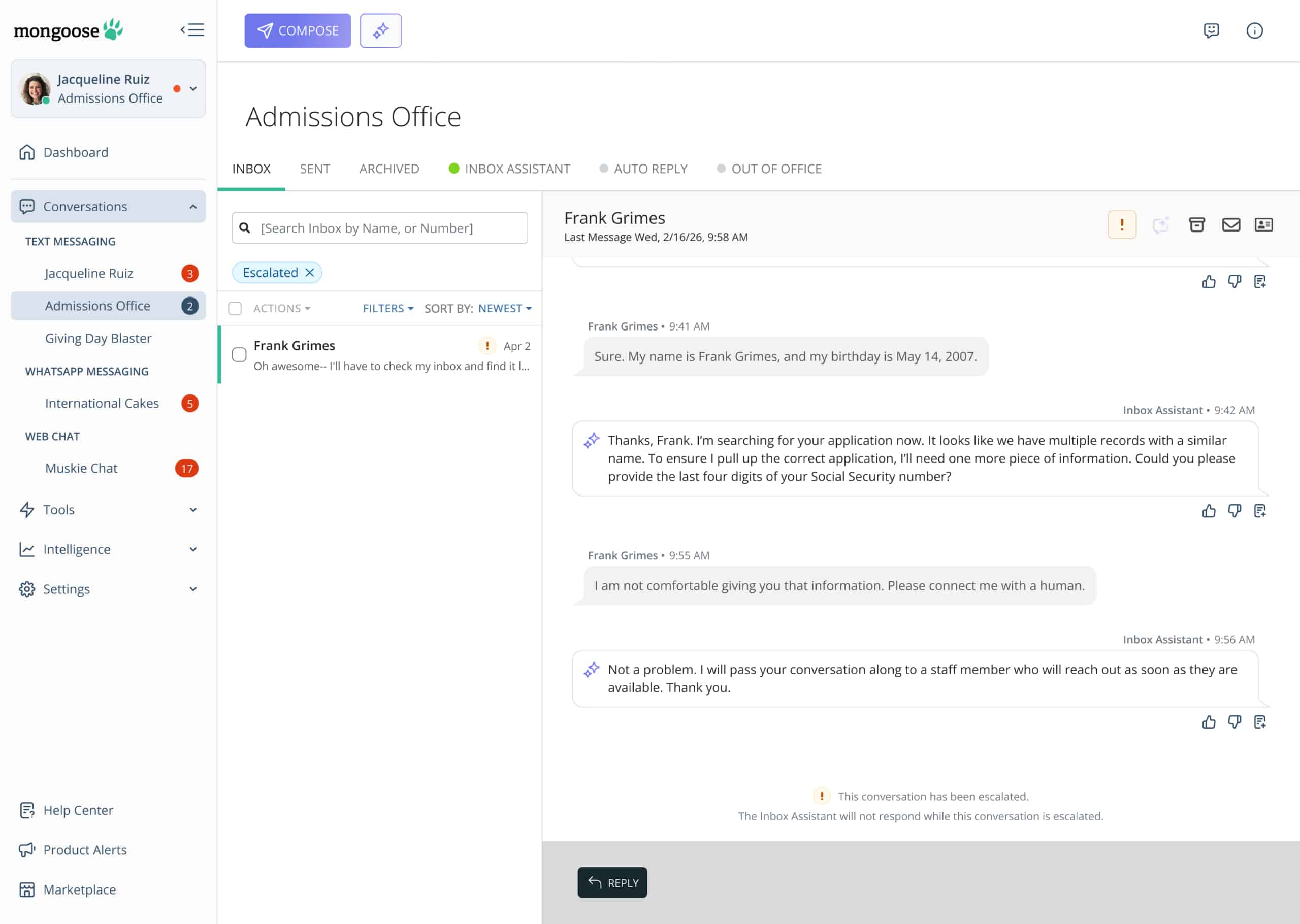
The edge cases are exactly where this matters most. Most conversations are predictable. The ones that aren’t, a student whose message doesn’t fit any pattern the system has seen before, are precisely where a person needs to be, and a well-built human-in-the-loop workflow is designed to notice when it’s out of its depth rather than guess.
This is also where Mongoose’s Outcome Agents fit into the bigger picture. The Application Completion Agent, Enrollment Yield Agent, and Student Retention Agent are still in development, with release timing to be announced, but they’re being built on the same principle.
A Student Retention Agent, for instance, is designed to use risk scoring to notice a student drifting from expected engagement patterns and act on it early. The scoring drives the outreach. A person still gets pulled in the moment the situation calls for judgment a model shouldn’t be making alone.
The third piece is the one buyers ask about least and should ask about most: does the student on the other end know they’re talking to an AI agent, and can they ask for a person at any point? In a well-built human-in-the-loop system, the answer is yes to both, every time.
That matters for a reason beyond good ethics. A student who suspects they’re being handled by something artificial and isn’t told so stops trusting the whole relationship, not just that one message. Transparency is what keeps a text exchange feeling like a real conversation with the institution instead of a script the student has to work around.
There’s also a simpler, practical reason to build it this way: a student’s own human input is often the fastest way to know the system got something wrong. A student who can say “that’s not what I meant” or ask for a person outright gives the team a signal that isn’t buried in a report somewhere. Artificial intelligence that hides what it is loses that signal entirely.
The same principle protects staff. An advisor working alongside the Inbox Assistant can see clearly which replies came from the Inbox Assistant and which came from a colleague, so accountability for a conversation never gets fuzzy.
That clarity is a big part of why advisor teams already stretched thin can actually trust the Inbox Assistant enough to let it take on real volume, instead of quietly double-checking everything it does.
Trust and oversight questions come up more from two groups than any others: prospects who are still deciding whether AI belongs anywhere near student conversations, and current customers rolling out AI Agents for the first time.
Some vendors call this category “agentic AI.” In a student success workflow, the label matters far less than whether a person still gets pulled in when it counts. Both groups care less about whether the technology is capable than about whether they’ll still be able to trust what it does once it’s live.
Building the right kind of AI workflow, one that a skeptical advising team will actually adopt rather than quietly route around, starts with the three pieces already covered here. Skip any one of them and adoption stalls, no matter how capable the underlying system is.
For a CIO or a director of IT, that question also has a security dimension. Mongoose’s AI Agents run on Azure OpenAI Service inside a private Azure environment, and student data is never used as training data for the underlying models. Human oversight and data governance aren’t separate conversations. They’re the same conversation, answered from two different angles.
None of this is a case for slowing adoption down out of caution alone. It’s a case for the specific version of AI agents worth adopting. The difference between a tool that responds and one that acts only matters if a person still gets the final say when it counts. That’s the version built to earn an advising team’s trust, not just their sign-off.
Get the loop right, and something changes for the advisor, not just for the student. Grace’s team isn’t spending its mornings triaging routine messages anymore. They’re spending them with the students the Inbox Assistant flagged, the ones who needed a person and got one immediately instead of three days later.
That’s the actual promise behind the design. Same team. More capacity. Better outcomes, with a person still in the middle of every conversation that needs one.
If you’re weighing how AI agents would fit inside your team’s existing workflow, and where you’d want the guardrails to sit, book a demo and we’ll walk through it against your own caseloads, not a generic script.