
AI Agents AI in Higher Education Blog Edtech Enrollment Inbox Assistant
Oct 15 2026
Text, Chat, or AI Agent? How the Pieces of the Mongoose Platform Work Together


The enrollment cliff has arrived: U.S. high school graduates peaked in 2025 and are projected to fall 13 percent by 2041. You can’t recruit your way off the cliff by buying more names. The institutions that hold steady will convert and keep more of the students already talking to them, which makes the enrollment cliff a capacity question as much as a marketing one.
Marcus Bennett, vice president of enrollment at a tuition-dependent private university, has the fall census on his desk and a budget meeting on Thursday. The class came in close to target, but it took more aid, more travel, and more purchased names than last year. Next year’s pool of high school graduates is smaller, and he already knows the board’s question: what’s the plan?
For many institutions, the plan has been to recruit harder. The enrollment cliff changes that math. With fewer students to recruit, the bigger opportunity sits with the students who already raised their hand, the inquiries, applicants, admits, and enrolled students who will enroll or stay if someone answers them in time.
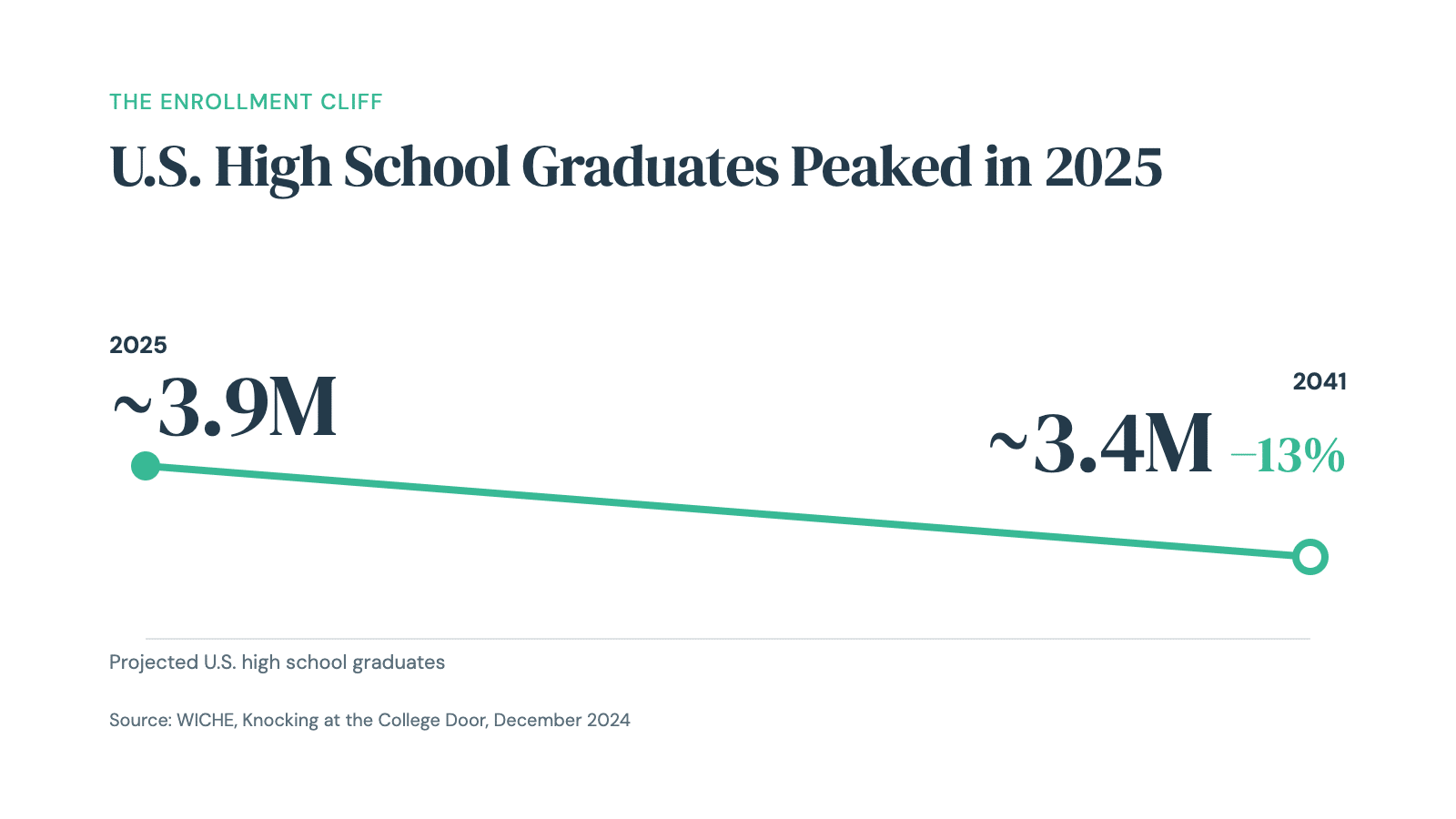
The enrollment cliff, sometimes called the demographic cliff in higher education, is the projected long-term drop in the number of traditional-age college students in the U.S. According to the Western Interstate Commission for Higher Education’s 2024 Knocking at the College Door projections, U.S. high school graduates peaked in 2025 at about 3.9 million and are projected to decline 13 percent, to about 3.4 million, by 2041.
In 2026, that means the cliff is no longer a forecast. Every recruitment cycle from here on draws from a smaller pool, and the competition for each student gets sharper, especially at tuition-dependent private institutions where a few dozen students can decide whether the budget balances.
When the pool shrinks, the instinct is to widen the top of the funnel. That helps only if your team can follow up with everyone who responds. Mongoose’s 2026 benchmark data from 4-year institutions shows how often that follow-up breaks down today:
Meanwhile, conversation tracks closely with enrollment. In an analysis of 304,913 first-year students, those with no text conversations yielded at 3 percent, and those with 21 or more conversations yielded at 94 percent. The analysis shows correlation rather than cause, since students leaning toward a school tend to talk more, but the climb is steady at every step.

For years, the answer to more students was more staff. There was only one lever to pull. That lever is no longer available. The strategies below focus on reaching more of the students you already have, with the team you already have.
See the full data: Get the 2026 State of Engagement in Higher Ed Benchmark Report for 4-Year Institutions.

Your website is often a prospective student’s first stop for deadlines, costs, and financial aid, and many of those visits happen after your office closes. In Mongoose’s benchmark data, 43 percent of Web Chat conversations arrive outside business hours. Even then, 74 percent of visitors get what they need without waiting for a staff member, and when visitors engage with AI-assisted chat flows, requests for live chat drop by half.
Mongoose Web Chat answers common questions on your admissions pages any time of day, captures contact information, and hands a conversation to a counselor when it needs a person. Across the benchmark dataset, Web Chat conversations captured 34,000 leads. At Buena Vista University, a private university in Iowa, adding Web Chat to admissions pages led to 234 new student inquiries, 20 additional enrollments, and $135,588 in net new tuition revenue.
Email still has a place, but it’s easy for a 17-year-old to ignore. Text gets read, and two-way Text gets answered. The format matters: in the benchmark data, Smart Messages, Mongoose’s interactive texts built to invite a reply, earn a 6.6 percent reply rate in enrollment, 2.3 times the rate of standard outreach. Messages that ask a question earn about twice the replies of messages that don’t.
Use Segments built from your CRM through the Slate connector (or Salesforce, Banner, and other connectors) to send stage-specific messages: a nudge to finish an application, a reminder about a missing document, a check-in before the deposit deadline. Each reply tells you where a student stands, which makes student replies some of the best enrollment intelligence your team has. When applicants stop answering, here’s how to diagnose ghosting in higher ed and win quiet applicants back.
Kettering University came to Mongoose after a decade of enrollment decline. Its enrollment team moved to a texting-first strategy connected to Slate, and deposits rose 60 percent year over year.
“If we want students to do something, we text. Emails are ignored. Mongoose makes everything easier, for us and them.”
Matt Fortescue, Director of Enrollment, Kettering University
Need a starting point? Download the admissions texting templates for nudges, aid reminders, visits, and onboarding.
The cliff is about traditional-age students. Adults who started college and left are a large and growing group. The National Student Clearinghouse Research Center’s 2025 Some College, No Credential report counts 37.6 million working-age adults who enrolled but left without a credential, up 2.2 percent from the prior year, and re-enrollment among them rose for the second year in a row.
These students are balancing jobs and families, so phone calls and long emails rarely fit. Short, personal texts do. At Jacksonville State University, the graduate admissions team sends recruiter-signed texts connected to Ellucian Recruit. First inquiry texts earn a 21 percent response rate, and campaigns average about 11 percent.
“Texting has been one of the most effective ways for us to reach busy adults.”
Madison Willingham, Coordinator of Graduate Recruitment Communication, Jacksonville State University
Tailor messages to what adult learners ask about first: flexible scheduling, transfer credit, cost, and support services. For more on serving this group well, read why colleges should support non-traditional students and how to do it.
International recruitment has gotten harder, which makes every conversation count for more. The Institute of International Education’s Fall 2025 Snapshot found new international student enrollment at U.S. institutions fell 17 percent from the prior year.
For students in much of Latin America, Europe, South Asia, and Africa, WhatsApp is the default way to communicate. Mongoose WhatsApp lets admissions teams answer questions in real time, send approved templates, and manage conversations in a Shared Inbox alongside Text. Thomas More University, a small Catholic university in Kentucky, runs Text for domestic students and WhatsApp for international students, both connected to Slate, with one person managing every campaign.
“From one mass text, we might get 25 students asking for the event link. For a school our size, that’s huge.”
Tony Otten, Associate Director of Admissions, Thomas More University
When new students are harder to find, every student who leaves costs more. Retention is the quiet half of any enrollment cliff strategy. Student Success teams in the benchmark data earn a 16.3 percent reply rate with Smart Messages, 4.1 times the rate of standard outreach, yet only 40 percent of those teams use them. Messages that ask a question earn 8.3 percent, compared with 3.5 percent without one.
The conversations that matter most for persistence are also the ones most likely to go unanswered. Financial conversations go unresolved 13.2 percent of the time, and technical issues 15.2 percent. Shared Inboxes and routing make sure those questions reach someone who can help. Learn more about Mongoose for student success.
Mongoose is the engagement platform more than 1,000 higher-ed institutions trust to reach every student. AI handles the routine so your team can focus on the conversations that matter.
Two-way conversations on Text, WhatsApp, and Web Chat are the core of the platform, and Mongoose sits above your CRM through connectors, so the system of record you already rely on becomes more useful. On Text, the Inbox Assistant, an AI agent that works in your inbox, answers common questions from approved institutional knowledge around the clock, drafts and triages replies, and flags conversations that need a person.
Mongoose is also building Outcome Agents, including the Application Completion Agent, the Enrollment Yield Agent, and the Student Retention Agent. All three are in development, with release dates to be announced. See how they fit together on the Mongoose AI Agents page, or explore Mongoose for enrollment.
Marcus’s answer to the board doesn’t have to be another round of purchased names. It can be a plan to answer every inquiry, re-engage the adults and international students who are already looking, and keep the students who enrolled. For more on building that plan across the year, see these admissions planning tips for higher ed leaders. A smaller pool rewards the institutions that make every conversation count.
“Prospective students were surprised to receive a response from a human rather than an auto-generated message.”
Samantha Adamczewski, Associate Director, Online Master’s in Data Science, University of Notre Dame
Notre Dame’s online data science program grew enrollment 84 percent in two years, from 25 students to 46, with a two-person team. If you want to see what your team could do with the students already in your funnel, book a demo with the Mongoose team.