AI Agents AI in Higher Education Blog Edtech Enrollment Inbox Assistant
Oct 15 2026
Text, Chat, or AI Agent? How the Pieces of the Mongoose Platform Work Together


The Giving Day strategies that raise more start with stewardship weeks before the ask, because texts work best when constituents can text back and reach a person. Segment by giving history, ask a question before you send a link, send when donors reply most (5 p.m. and Sundays), and put named staff on the inbox for the full 24 hours.
At 7:40 p.m. on Giving Tuesday, a 2016 graduate replies to your text: “Is this actually from the university? I gave last year and never heard back.” Hannah Foster, the director of annual giving, is at the campus watch party with her phone in her bag. The match closes at midnight, and the reply gets read Wednesday morning.
Nobody on Hannah’s team did anything wrong. Their Giving Day strategies were sound, and every text went out on time. What failed was everything around the send: the alumna hadn’t heard from the university since her last gift, the text arrived as an ask with no person behind it, and her reply landed in an inbox nobody was watching.
The Giving Day strategies that raise more start weeks before the ask. Thank last year’s donors, segment by giving history and affinity, ask a question before you send a link, and put named staff on the replies for the day. Here’s what to send, when, and to whom, for Giving Tuesday on December 1 or a spring Day of Giving.
For most advancement teams, the result gets decided in the months before it, by how consistent donor engagement has been all year. The VAESE and CASE staffing benchmark cited in Mongoose’s 2026 Benchmark Report on 4-year engagement puts the load at about 25,000 alumni per engagement staffer and finds that roughly 80 percent of alumni never hear from anyone in a given year. When the only text an alum gets all year is an ask, that ask has to carry the whole relationship.
Your team didn’t fail. The math never worked. The breakdowns show up in three places.
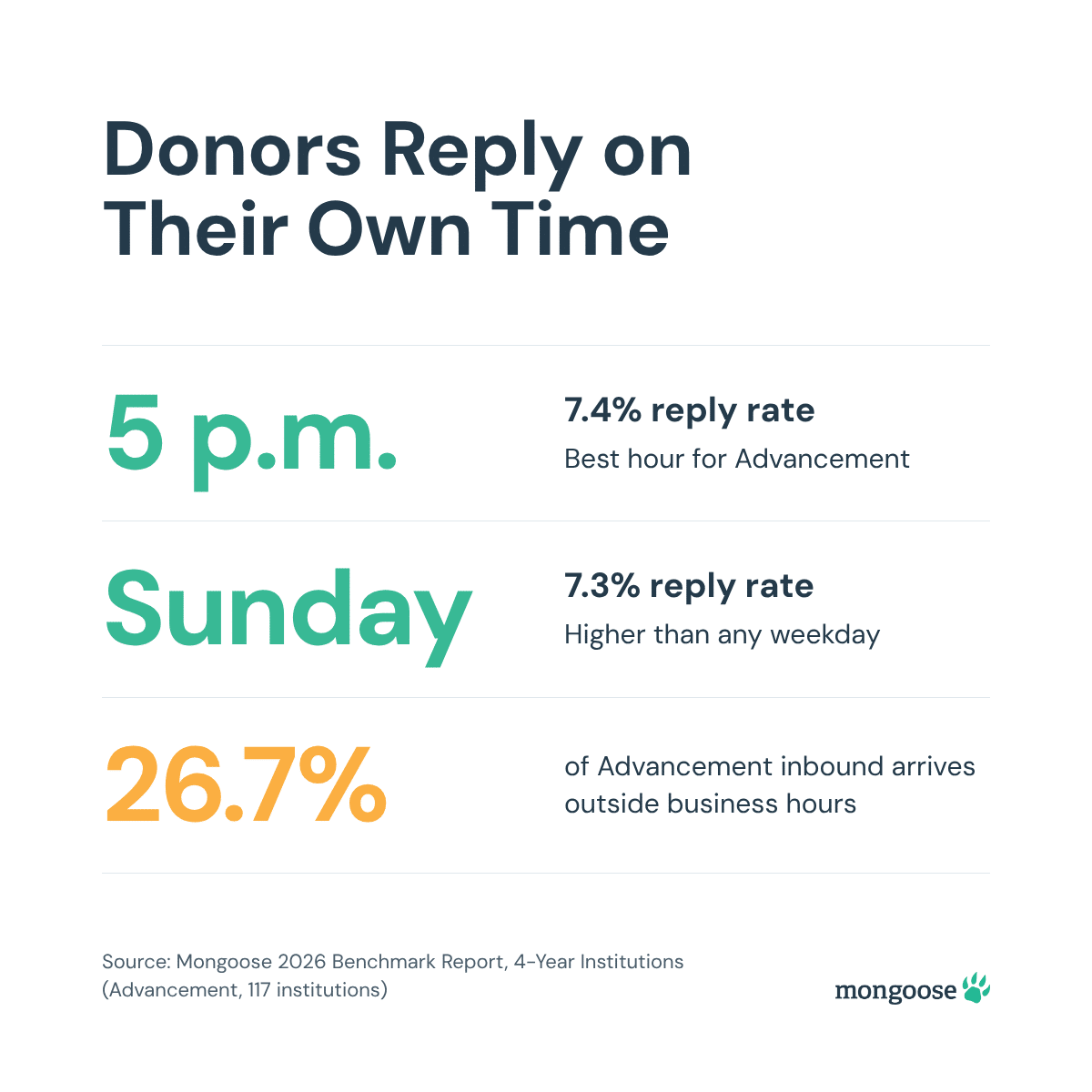
Asks tend to go out at 10 a.m. because that’s when the office opens. Donors reply on their own time. Across 280,425 Advancement conversations at 117 four-year institutions in Mongoose’s 2026 Benchmark Report, the best single hour for replies was 5 p.m. (7.4 percent) and the best day was Sunday (7.3 percent), higher than any weekday. More than one in four inbound Advancement messages (26.7 percent) arrived before 8 a.m., after 5 p.m., or on a weekend.
The strongest Advancement Smart Messages in the benchmark data pull from the CRM: last gift amount, fund name, class year, and membership tier. A text that names the scholarship fund someone supported last year starts a different conversation than one that names the university.
The thank-you is where most programs go quiet. Donor stewardship conversations earned 92.9 percent appreciation in the benchmark data, the highest of any topic across every team in the report, and only 0.7 percent went unresolved. Yet in the same data, teams send far more giving-day and event messages than thank-yous.
Start from your CRM or donor management system, not a single list. If your team runs on Raiser’s Edge NXT, the Mongoose connector imports constituents from an NXT list and writes texts back to NXT as Actions or Notes, so giving history stays in your system of record. From there, build Segments around what each group needs to hear before the day.
| Segment | Before the day | On the day |
|---|---|---|
| Last year’s Giving Day donors | A thank-you with one specific result their gift paid for. No ask. | “Can we count on you again?” with the match details |
| Lapsed donors | A reconnection note about the fund or program they last supported | An ask tied to that same fund |
| Young alumni (last 10 years) | A class-year challenge or a callback to their senior class gift | Class-year leaderboard progress |
| Never-givers who’ve replied to you before | Event or reunion follow-up, framed around participation | “Any gift counts toward participation” |
| Hold out | Anyone opted out, plus major donors and prospects in active cultivation (coordinate with gift officers before the send) | |
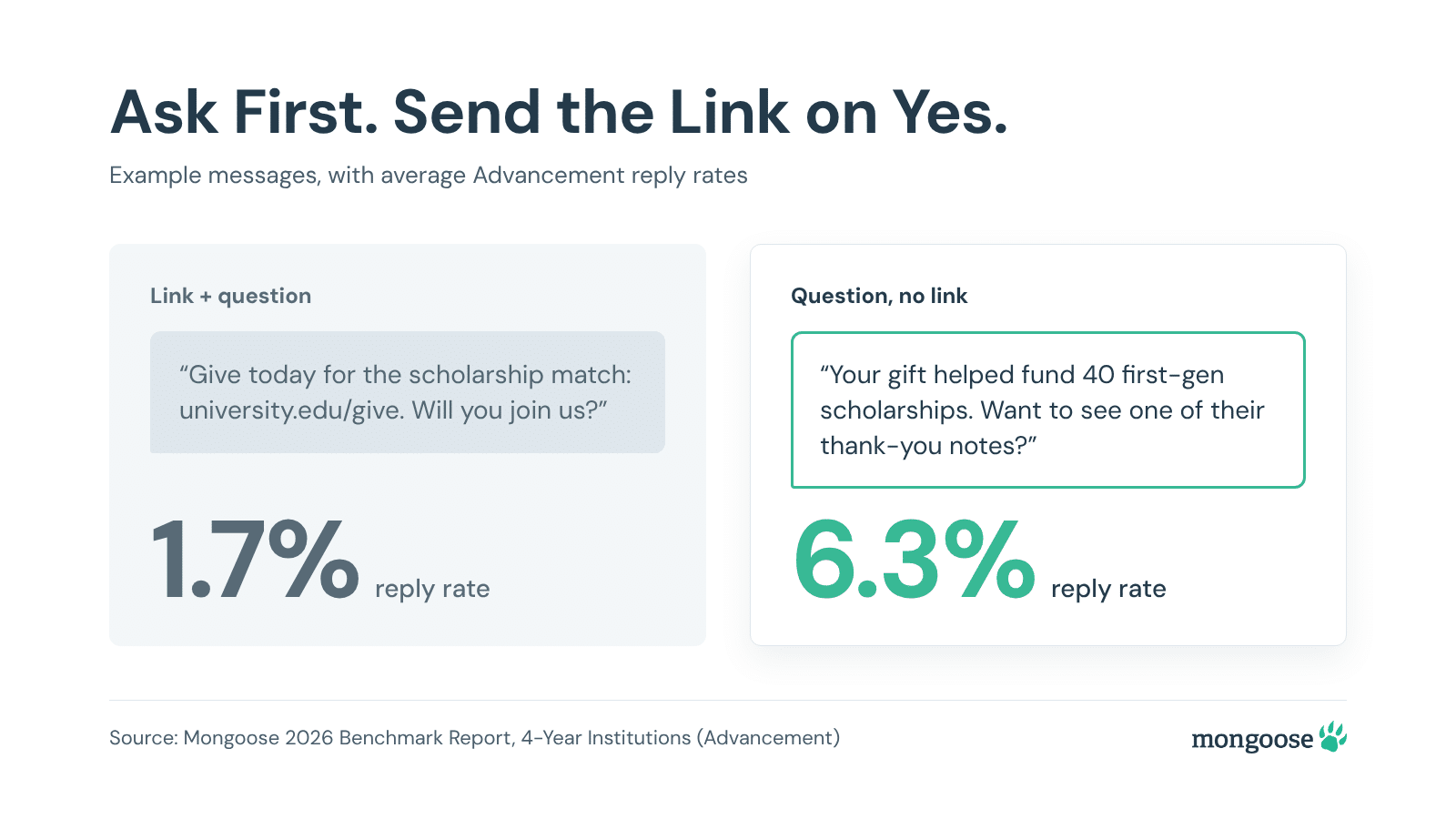
Two rules keep the segments honest. Every message comes from a named sender (“This is Hannah with the annual giving team”), and every opener ends on a question. In the benchmark data, Advancement messages with a question earned a 6.0 percent reply rate against 2.5 percent without one.
Here’s the step-by-step sequence, with dates for GivingTuesday on December 1, 2026. For a spring Day of Giving, start the same sequence six to eight weeks out. Run it alongside your email marketing: email carries the full story and the donation form, and texts start the conversation.
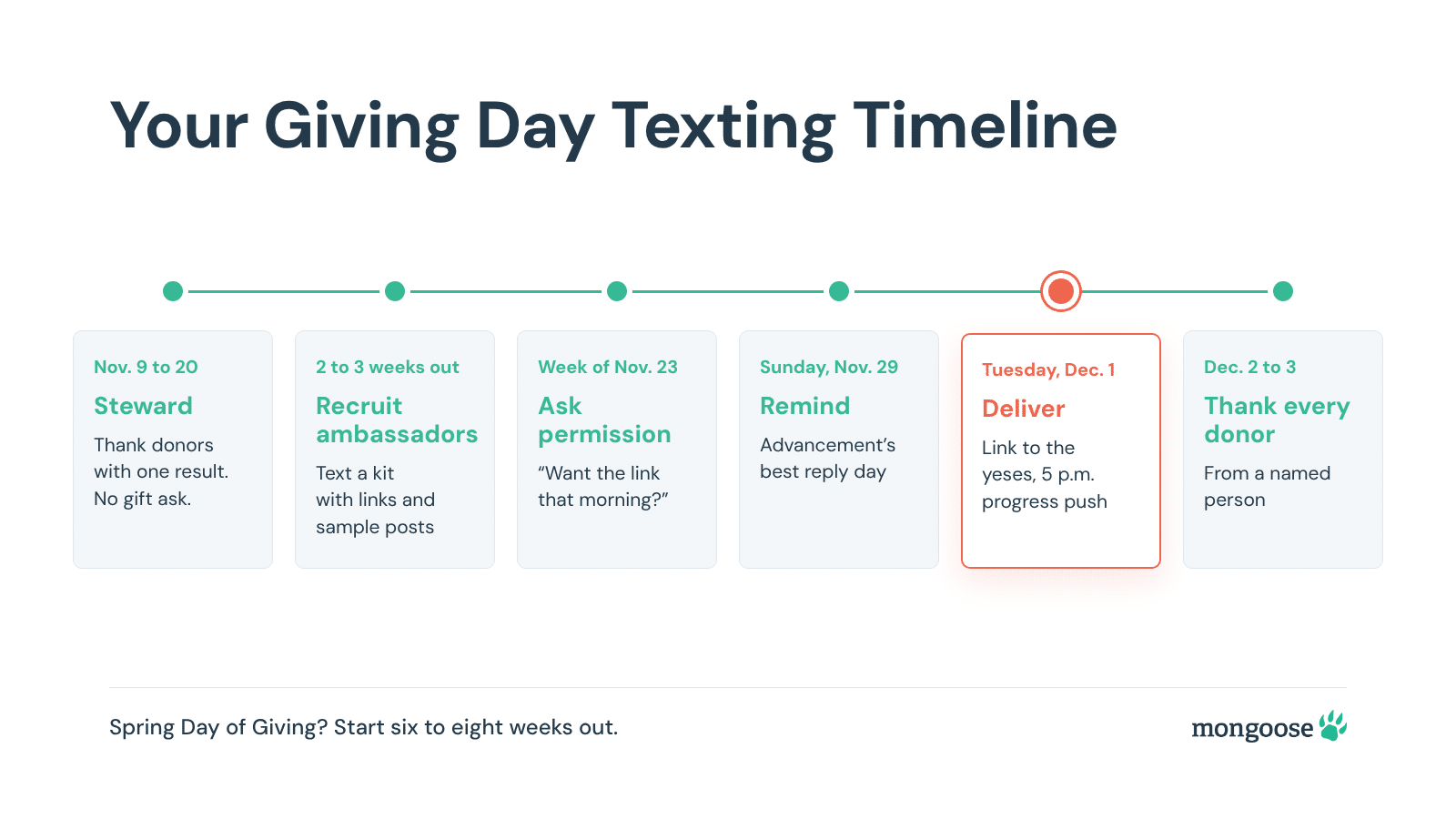
Thank last year’s donors with one result and a question. Use the permission-to-send-the-link pattern from the benchmark data: ask first, and send the link only to people who reply yes.
“Hi [First Name], it’s Hannah at [University]. Your gift helped fund 40 first-gen scholarships. Want to see one of their thank-you notes?”
New numbers get a consent and contact-update message first, which the benchmark data shows is often the first text an advancement program sends.
Peer-to-peer asks from ambassadors multiply your reach, and recruiting them by text is a recurring Advancement use case in the benchmark data, often paired with leaderboards and prizes. Start with alumni volunteers and last year’s donors who replied to your thank-you, using a Yes/No Smart Message so every yes gets the next step automatically.
“Would you text five classmates on December 1 to help us reach the scholarship match?”
Then text each ambassador a short kit: their personal giving link, two sample messages they can forward, a social post with your Giving Day hashtag so their outreach matches your social media campaign, the challenge schedule, and a staff member they can text with questions.
Preview the day and ask whether they want the link. A Smart Message with a Yes/No response can send a pre-written follow-up automatically and track replies for up to 72 hours. Keep Thanksgiving Day itself quiet.
“GivingTuesday is next week, with a $50K match for the [Fund]. Want me to text you the link that morning?”
Sunday was Advancement’s highest-reply day in the benchmark data. Confirm the plan with everyone who said yes, and give non-responders one more chance to opt into the day-of link.
Send the donation page link in the morning to the people who asked for it. They’re expecting it, so the link is the point. Save the larger send for 5 p.m., when replies peak, framed around progress (“We’re 212 donors away from the match”). In the final two hours, follow up with constituents who replied but haven’t given. Schedule every send in advance so the team can work the replies.
Hourly challenges and matching gifts create a sense of urgency that keeps the day moving, and local business partnerships can fund the matches. Multi-message sequences built around matching gifts are the dominant Advancement Smart Message use case in the benchmark data. Assign each challenge to the segment most likely to answer it, like a young-alumni hour at 5 p.m., and text ambassadors before each one starts.
Thanking donors from a named person, with no ask attached, is the first stewardship message for next year, and it’s the one most teams skip.
See the plan in action: how UNF’s annual giving team sent 40,000+ segmented texts and passed its Giving Day donor target.
Expect some opt-outs, and make them easy. Constituents can reply STOP, STOPALL, UNSUBSCRIBE, CANCEL, END, or QUIT, and the carrier honors it with one confirmation text. A few details protect the rest of your list:
Segmentation does the most work here. UNF’s annual giving team sent more than 40,000 texts and saw fewer than 1,000 opt-outs. “Being very particular about your audience means people are less likely to opt out,” said Olivia Newsome, director for annual giving at UNF.
This is the part of the plan most teams leave blank. In the 2026 Benchmark Report, the median Advancement shared inbox held 2,150 donor contacts, and the busiest 10 percent held 8,359 or more. Build the reply plan like a phonathon shift schedule:
The aim is that Hannah’s 7:40 p.m. reply gets an answer before midnight, from someone who can say thank you by name.
See What Your Advancement Team Can Do With More Capacity
Walk through your Giving Day plan with our team, from the first thank-you text to who answers the replies on the day.
The University of North Florida finished with 5,884 Giving Day donors against a target of 4,750, its strongest yet. The team uploaded more than 30 segmented lists, each with its own message. “In Mongoose, it’s easy to do big things, and it’s easy to do small things,” Newsome said.
At Presbyterian College, the most recent Giving Day brought in 902 donors and $390,000, more than 150 donors past its target after falling short the year before. During its April Giving Day, a single text with a custom link drew 132 donors and $27,751. When the team checked which links drove gifts, “Mongoose texts were the top performers,” said Amanda Dowdle, director of annual campaigns and development officer. “Texting with Mongoose makes it feel like there’s a real person on the other end.”
That fits the benchmark finding that links lower reply rates. The stewardship weeks lead with questions, and on the day itself, the link is what donors who said yes are waiting for.
Giving Day is one day on the calendar. The constituents who give on it spend the rest of the year deciding whether the university knows who they are. The teams pulling ahead treat the January thank-you and the quiet check-in with a young alum as part of next year’s plan, with a person on the other end of every text.
See how advancement teams use Mongoose for giving days, year-end appeals, and stewardship on the advancement solutions page, or book a demo to walk through your Giving Day texting plan with our team.